
Money hazards: What if, after a 4-year bull run, the stock market moves sideways for years?

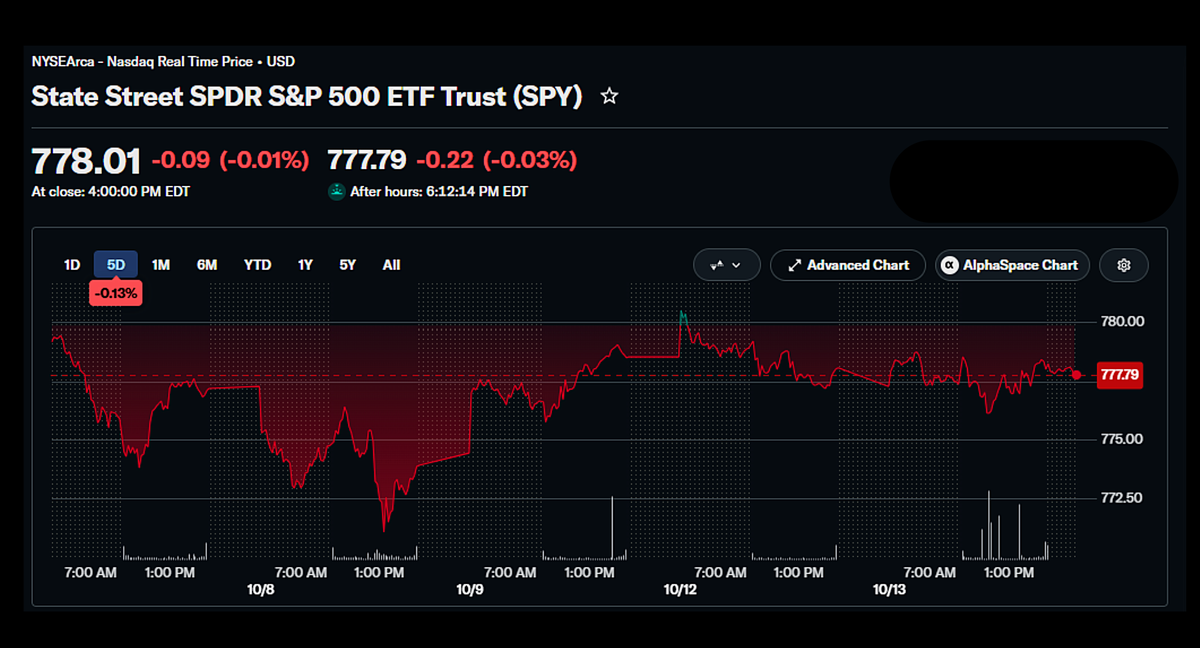
The S&P 500 just marked the four-year anniversary of a bull market on October 12, 2026. With nearly a 120% gain since its October 2022 low, the question looms: Can it carry that momentum into a fifth year?
Over the past two months, the S&P ETF SPY has traded within a range, barely moving from its August 4th open of $771.33 to yesterday's close of $778.01.
Across markets, a years-long period of treading water has historic precedent. This is especially true when lingering inflation meets growing earnings and shrinking valuations — resulting in expanding multiples.
The recent history of sideways markets
- 1966-1982 (US): The Dow ended roughly where it started in nominal terms. With high inflation, investors lost a lot in real terms.
- 2000-2013 (US): The S&P 500 hit its March 2000 high of about 1,527 and didn't durably clear it until 2013, with two crashes in between. Dividends cushioned it, but the price index went nowhere.
- Japan, 1989-2024: The Nikkei took about 34 years to regain its 1989 peak. That's the extreme case, and it involved a unique bubble and demographics.
What a sideways market actually feels like
It's rarely quiet. Those flat decades contained several 30-50% drops and 70-100% rallies. The index ends up where it began, but the path is rough, and buy-and-hold investors take the volatility with little to show for it.
Read more: Is your financial advisor using AI for investment recommendations — and hiding it from you?
Where the money hazards lurk
Chasing momentum, using leverage, and counting on a rising index to fund near-term spending all do badly when the stock market lingers in a range. Retirees face the worst outcome because withdrawals during early drawdowns lock in losses (sequence-of-returns risk).
Of course, nobody can reliably call a sideways market. Strong runs have also continued far longer than skeptics expected, and sideways markets only look obvious in hindsight.
A reasonable approach is to hold a diversified mix you can stick with through either outcome rather than betting on one.
Avoid a money hazard
During sideways markets, the following strategies help eke out a gain:
- Dividends and cash flow: When price appreciation stalls, income becomes most of the return.
- Valuation discipline: Cheaper segments (value stocks, small caps, many non-US markets) outperformed the expensive large-cap growth leaders after 2000.
- Rebalancing: Trading the swings by selling strength and buying weakness adds return in range-bound markets.
- Bonds and real assets: These depend on the inflation and rate backdrop. In the 1970s, bonds performed poorly, and commodities did well. In 2000-2013, bonds did well.
- Ongoing contributions: Dollar-cost averaging benefits from volatility around a flat trend.